
Ideas for learning spaces
Makedo Invent Kit Spotlight: Classroom Uses, Planning Math and Ideas Beyond the Box
Classroom Spotlight · No. 01 · Makerspace & Creative Learning
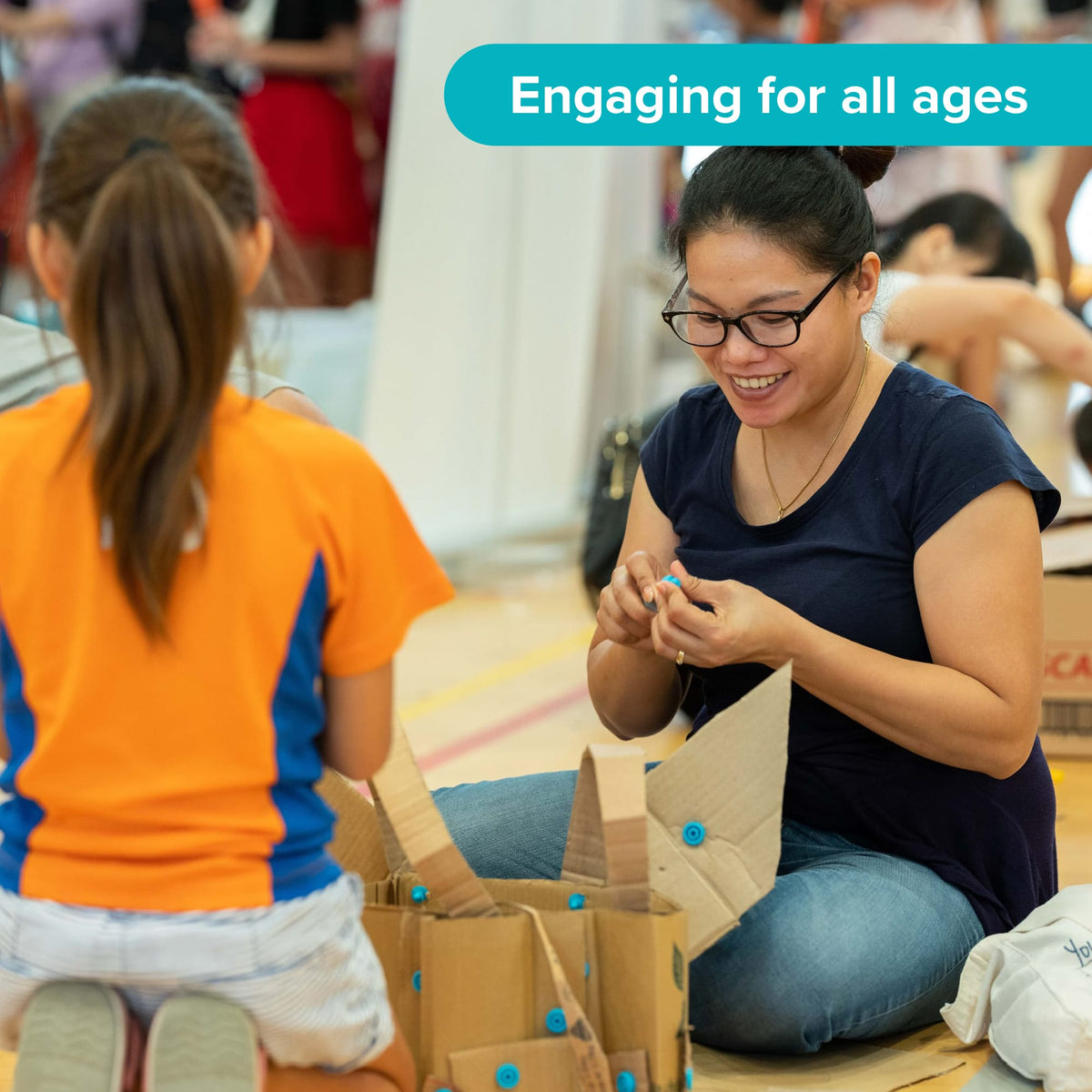
Most classroom building kits ask you to buy the building material. Makedo asks you to collect it. The Makedo Invent kit is a set of reusable tools and screw-in connectors that turn ordinary corrugated cardboard into a construction material, and it is sized for a whole class of 12 to 24 makers at once.
This spotlight covers what is verifiably in the box, how the tools divide across a real class, and practical ways to use the kit beyond the first cardboard castle.
About Classroom Spotlight: each article in this series looks at one product through a classroom lens. Product facts come from the manufacturer's published materials and are linked at the end. Planning math is our own calculation from those facts. Use-case ideas are clearly marked as suggestions from the STEMclassrooms team, not manufacturer claims.
At a glance
| What it is | A cardboard construction toolkit: saws, folding tools, drivers and reusable connectors |
|---|---|
| Pieces | 360 |
| Group size | About 12–24 makers working at the same time (manufacturer guidance) |
| Best fit | Pre-K through elementary classrooms, makerspaces, libraries and after-school programs |
| Age grading | Safety tested to age 3+; Makedo says makers 4 and up can build with adult help |
| You supply | Corrugated cardboard (not included) |
| Screen or power needed | None |
See the Makedo Invent kit and current pricing

What's in the box
- 14 Safe-Saws: rounded-tooth saws designed for cutting cardboard
- 7 Fold-Rollers: roll a perforated line for clean folds, or trace a cutting path for the saw
- 7 Scru-Drivers and 12 Mini-Tools: twist connectors in and back out (the Mini-Tool is a smaller driver)
- 240 Scrus: reusable connectors that join up to three layers of corrugated cardboard
- 80 Scru+: longer connectors for thicker stacks, which also attach 3D-printable add-ons such as hinges
- 1 inspiration poster
The core skill set is short enough to teach in one lesson: cut, fold, poke, connect. Makedo's own getting-started challenge asks students to use all four to make something that rolls.

What makes it different
The material is free, local and replaceable
Makedo sells tools, not cardboard. That changes the economics of a building lesson: a failed prototype costs a box, not a refill pack. Makedo suggests collecting standard corrugated cardboard from recycling bins, grocers, hardware stores, and bike or appliance shops.
Builds come apart, so iteration is built in
A Scru releases with a few turns of the driver and goes straight back into the next build. That makes "test it, take it apart, improve it" the default rather than a lesson you have to force. Glue and tape lock in the first idea; Scrus let students change their minds.
It scales from one table to the whole room
The tool counts are designed for parallel making. Twelve Mini-Tools alongside seven full-size drivers means more students can be connecting at the same moment, which matters when a whole class is building.
Classroom math: how the kit divides
Group size changes how much each student gets to handle. These figures are our own division of the published contents. Your age group, project and supervision will change what works best.
| Per team | 12 makers in 6 pairs | 24 makers in 8 teams of 3 |
|---|---|---|
| Safe-Saws (14) | 2 per pair, plus 2 spare | 1–2 per team |
| Drivers and Mini-Tools (19) | About 3 per pair | 2 per team, plus 3 spare |
| Fold-Rollers (7) | 1 per pair, plus 1 spare | Shared: 7 rollers for 8 teams |
| Connectors (320) | About 53 per pair | 40 per team |
What this suggests: at 24 makers, folding is the bottleneck. A simple fix is a shared fold-and-score station, or a rotation where teams cut first and fold second. At 12 makers, there is room for every pair to work on its own build without waiting.
For larger groups or a second room, Makedo's smaller Create kit (260 pieces, 4–8 makers) adds another station. A Scru Combo Refill covers connectors that go missing over a term.
Eight ways to use it beyond the obvious
The ideas below are suggestions from the STEMclassrooms team, built on the kit's verified features. They are not manufacturer claims.
1. Build terrain for screen-free coding robots
Coding robots such as Cubetto and the Matatalab Tale-Bot Pro travel across a grid. Students can build cardboard landmarks such as bridges, gates, houses and mountains, then program a route that visits or avoids them. Match each structure to the square size of your robot's map, and keep the travel path clear.
2. Build a cardboard controller for Makey Makey
Cardboard is not conductive, but aluminum foil is. Students can build a sturdy cardboard game pad or musical instrument with Makedo, add foil touch pads, and wire them to a Makey Makey. Makedo builds the structure, and the foil carries the signal. This works best with upper elementary students.
3. Retell a story by building its setting
After a read-aloud, teams build the most important place in the story and use it to retell the plot in order. Pair this with a storytelling robot so students program a character through their own set.
4. Bring measurement off the worksheet
Makedo lists "body trace" among its classroom project ideas: students trace a classmate on cardboard and build from the outline. Turn it into a measurement lesson by comparing lengths, estimating before measuring, or scaling the figure to half size.
5. Run a true engineering challenge with constraints
Towers, bridges, mazes and shelters all appear in Makedo's project ideas. Add a constraint, such as 30 connectors, one sheet of cardboard or a load the bridge must hold. Students test, take apart and rebuild. Because the Scrus come back out, a second and third attempt costs nothing but time.
6. Turn the cardboard collection into a lesson
Before the first build, students can plan a cardboard drive: where to collect it, how to sort it by thickness, and how much the class needs. Makedo's free hub includes a Recycle City lesson that fits this sustainability angle.
7. Set up a drop-in maker table
Libraries and after-school programs need activities that reset quickly. Builds come apart, Scrus go back in the case, and the table is ready for the next group. A Makedo Tool-Case keeps the small parts in one place.
8. Make props and costumes for school events
A class play, a book week parade or a science fair display all need lightweight structures. Cardboard costumes and props built with Makedo can be taken apart after the event, and the connectors go back into the kit.


Before you buy: honest considerations
- You need a cardboard plan. The kit has no building material. Decide where cardboard will come from and where you will store it between lessons.
- Tools are shared at full capacity. At 24 makers, plan stations or rotations, especially for folding.
- Count the small parts back in. Scrus are small and easy to lose. Build a two-minute pack-up routine into every session.
- Cardboard has limits. Builds suit indoor, temporary and light-duty projects. They are not a substitute for permanent furniture or outdoor structures.
- Mind the youngest makers. The kit contains small parts and is not for unsupervised children 3 and under. Makedo recommends adult help for younger makers.

Pairs well with
- Makedo Tool-Case to store tools and Scrus between sessions
- Makedo Design Journal so students sketch and plan before they cut
- Scru Combo Refill to replace connectors over a school year
- Cubetto+ or Tale-Bot Pro for coding through cardboard worlds
- Makey Makey Classic for interactive cardboard inventions
Browse the full Makedo range or everything in Makerspace & Creative Learning.
Frequently asked questions
How many students can use one Makedo Invent kit?
Makedo recommends the Invent kit for about 12 to 24 makers working at the same time. At the top of that range, students share tools, so stations or rotations work best.
Does the Makedo Invent kit come with cardboard?
No. Makedo sells tools and connectors only. The kit is designed for standard corrugated cardboard, which schools can collect from recycling, grocers, hardware stores and appliance or bike shops.
What age is Makedo for?
Makedo is safety tested to an age grading of 3+, and children 3 and under should not have unsupervised access. Makedo says makers 4 and older can build with adult help, and older children can build on their own.
Are Makedo Scrus reusable?
Yes. A Scru releases with a few turns of the driver and can be used again in a new build.
Is Makedo safety tested?
Makedo states that its products are tested by an independent laboratory to global toy standards, including ASTM F963 and CPSIA in the United States and EN-71 in Europe. The plastic parts are made without PVC, BPA, phthalates or lead, according to the manufacturer.
Are there lesson plans for Makedo?
Makedo offers a free online education hub with lesson plans, design challenges and quick activities; a free account is required for full lesson plans. Examples include a Tallest Tower lesson and a Recycle City lesson.
Planning a class set or a makerspace?
Tell us your group size and how you plan to use the kit, and we'll put together a quote that fits your classroom.
Sources
- Makedo: Invent kit product page
- Makedo Help: How much do I need for my classroom?
- Makedo: Frequently asked questions
- Makedo Hub: Introducing tools to students
- Makedo: Five reasons educators love Makedo in the classroom
- Sphero Support: Conductive materials for the Makey Makey bit
STEMclassrooms sells the products mentioned in this article. Product facts were checked against the manufacturer sources above in November 2026. The planning math and use-case ideas are original STEMclassrooms suggestions. Review projects and supervision needs for your own learners and setting. Images courtesy of Makedo.